Cafe & coffee shop / Demand forecasting
Demand forecasting for cafes and coffee shops
By the numbers
Source: National Restaurant Association
Source: National Restaurant Association
Source: National Restaurant Association
Source: National Restaurant Association
The cafe & coffee shop problem
How AI helps a cafe or coffee shop here
- Bake and order to a forecast, not a hunch. AI projects next-day demand per item from your POS mix, so croissant counts and milk pars track real patterns instead of yesterday's gut call, the shift that lifted Blue Bottle's ordering accuracy by 8% accuracy gain.
- Staff the spike, not the average. Forecasts at 15-minute resolution let you schedule the bar to the 7-to-9am peak rather than a flat headcount, with Lineup.ai marketing its sales forecasting as 35% more accurate than traditional methods.
- Stop binning perishables. Tighter pastry and milk orders cut same-day waste, the most expensive kind on a 32.0% / 32.4% of sales food cost where nothing carries to tomorrow.
- Turn pre-orders into known demand. Mobile and loyalty orders convert a guessed rush into booked volume you can bake and staff against, and First-party ordering guests attach to loyalty at 41% vs 3%.
- Right-size your hours. AI reads your sales history to prove which opening and closing hours actually pay, the same analysis that saved one operator $4,000 saved.
- Factor the weather and the calendar. Better models ingest local weather so a cold snap, a heat wave, or a downpour shifts the forecast before it hits the bar.
Forecast the morning rush, cup by cup
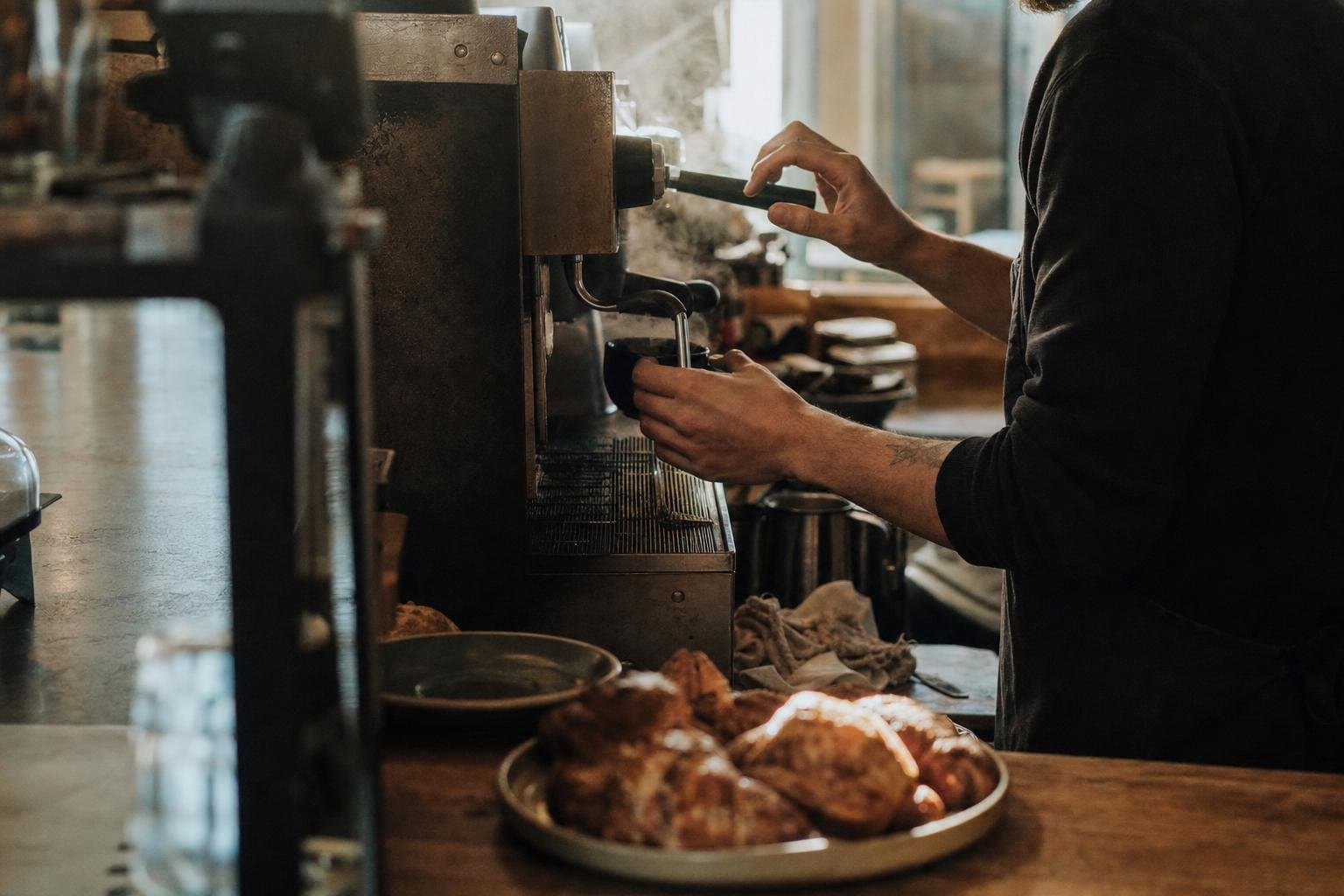
A cafe's demand curve is not a gentle hill, it is a spike. A large share of Covers and sales land between roughly 7 and 9am, which means a prep or scheduling error there costs far more than the same error at 2pm. AI forecasting tools read your Point of sale (POS) history at the item and interval level and project the next day's or next week's volume, so you can set an opening Mise en place and a bar schedule to the actual curve instead of a gut average. Lineup.ai markets its forecasting as 35% more accurate than traditional methods, and 7shifts, used across 55,000 restaurants / 1.5M workers, ties an AI demand forecast straight into the shift schedule.
For most independent cafes the forecast engine is already inside the POS you run. Toast and Square for Restaurants both surface sales forecasting and labor guidance from your own transaction history, so the first move is usually turning on and trusting what you already pay for, not buying a new platform. (Compare the landscape in our tools directory.)
Order pastry and milk to a number, not a hunch
The perishables that define a coffee shop, whole and oat milk, croissants and muffins, laminated dough and cut fruit, are exactly the items a forecast helps most, because their waste is total and same-day. An over-order does not carry to tomorrow, it goes in the bin. With food cost at a median 32.0% / 32.4% of sales and menu prices up +4.1% in 2025, every unsold tray is a bigger hole than it used to be. AI par-level and inventory tools such as 5-Out and MarginEdge convert the sales forecast into a suggested order per item, and MarginEdge runs a flat $350 per location/month for automated invoice processing and food-cost tracking.
Be honest about scale. Touchless waste-tracking systems like Winnow, which reports cutting kitchen food waste 50% waste cut and food cost 2-8% food-cost savings across 3,500+ sites, 94 countries, are built for hotel and high-volume kitchens, not a two-bar cafe. The cafe-sized win is smaller and real: a forecast tight enough to bake one less tray, plus a daily habit of logging what you actually threw out so next week's number improves.
Your regulars are the forecast, and the retention lever
A cafe's edge over a chain is that the same faces come back four mornings a week, and every one of those visits is First-party data a forecast can learn from. When guests order through your app or join loyalty, you capture who bought what and when, which sharpens the demand model and, separately, is the strongest retention tool you have. 57% of adults have used mobile ordering recently, 60% of loyalty members prefer an app to a punch card, and first-party guests attach to loyalty at 41% vs 3% versus guests you meet through a marketplace.
Mobile pre-order does something a forecast alone cannot: it turns demand from a guess into a fact. An order placed at 7:12 for 7:30 pickup is known volume you can bake and staff against, smoothing the very spike that breaks the morning. Toast and Square for Restaurants bundle online ordering and loyalty with the same POS that produces your forecast, so the data loop closes without stitching vendors together.
Where to start, and what the model still cannot see
Start with the decision that moves the most money: your hours and your opening bake. Independent operator Cali BBQ used its POS's AI to analyze historical sales and stay closed until 11am, saving $4,000 saved in unnecessary labor, a call the model made in under a minute. A cafe has the same lever in reverse: proving the 6am hour pays for itself, or that Sunday afternoon does not.
Two honest limits. A forecast needs history, so a new cafe or a new item runs on thin data for its first weeks, and you steer by hand until the model has enough Tuesdays to learn from. And a model trained on your own past cannot see the street: a marathon reroute, a school calendar, a construction detour, or a burst of rain will beat the forecast, which is why the operator, not the algorithm, owns the final order. Used this way, forecasting is not automation of your judgment, it is a sharper input to it. For how this works beyond a cafe, see the general demand forecasting overview.
Questions cafes and coffee shop operators ask
How much does AI demand forecasting cost a small cafe?
What is a realistic return for a coffee shop?
How much sales history do I need before the forecast is any good?
Can it forecast individual pastries, or just total sales?
Does weather really move coffee demand enough to forecast?
References
Every figure on this page drills down.
17 sourced statistics cited here across 13 publications. Each number links to the research hub, and each entry there links out to its primary source.
- 01Provectus, Reducing Food Waste Across 100+ Cafes with AI Demand Forecasting (2024)
- 02National Restaurant Association, Restaurant operators kept food cost ratios in check in 2024 (2025)
- 03U.S. Bureau of Labor Statistics, Consumer Price Index: 2025 in review (2026)
- 04ReFED, Food Waste Remains Stubbornly High Despite Signs of Progress, According to New ReFED Report (2025)
- 05Lineup.ai, Lineup.ai | AI Forecasting Software for Restaurants (2026)
- 06Paytronix, Online Ordering 2024 Trends: Converting Guests from Third- to First-Party (2024)
- 07Restaurant Technology (Shawn Walchef, Cali BBQ) on Substack, The Future of Tech is Agentic: How Toast IQ Saved Us $4,000 (2025)
- 087shifts, AI Information Page for 7shifts (2026)
- 09MarginEdge, Restaurant Invoicing Software Pricing (2026)
- 10Winnow, Winnow: The Leading AI Food Waste Prevention System for Commercial Kitchens (2026)
- 11National Restaurant Association, From Trend to Transformation: Off-Premises Dining Now Essential (2025)
- 12National Restaurant Association, Get with the program: Building loyalty grows business (2024)
- 13National Restaurant Association, Elevated labor costs had a significant impact on restaurant profitability in 2024 (2025)
Your next service / Ready when you are
Start with demand forecasting for your cafe or coffee shop
Turn what you have learned into a focused brief. Start with the job that matters most, and keep the tools that already work for your restaurant.
Describe it. Review it. Keep improving it. Check connections and costs before going live.