Fine dining / Inventory & food cost
Inventory & food cost for fine dining restaurants
By the numbers
Source: National Restaurant Association
Source: National Restaurant Association
Source: National Restaurant Association
Source: National Restaurant Association
The fine dining problem
How AI helps a fine dining restaurant here
- Turn every purveyor invoice into a live cost. Tools like MarginEdge and xtraCHEF read invoices as they arrive, so the price of that day's diver scallops updates your recipe costs before service, not at month end.
- Cost every plate on your tasting menu to the gram. Apicbase holds recipe-level Mise en place and flags when a dish's Food cost percentage drifts as market prices move.
- Forecast covers so you order to the reservation book. Lineup.ai markets forecasts 35% more accurate, which matters most when one case of a $40-per-pound ingredient is the line between 86ing a course and dumping it.
- Catch waste before it is money. Winnow reports 50% waste cut and 2-8% food-cost savings, and in a kitchen where trim is caviar-adjacent, that curve is steep.
- See a daily P&L instead of a monthly surprise. Restaurant365 and MarginEdge rebuild Prime cost every morning, so a bad week is a Tuesday problem, not a discovery on the 30th.
- Know what to 86 (to 86 an item) early. Forecasting plus real-time counts tell you which luxury item will run out at 8:45, so the floor can steer guests before the kitchen is caught short.
The economics of the fine dining walk-in
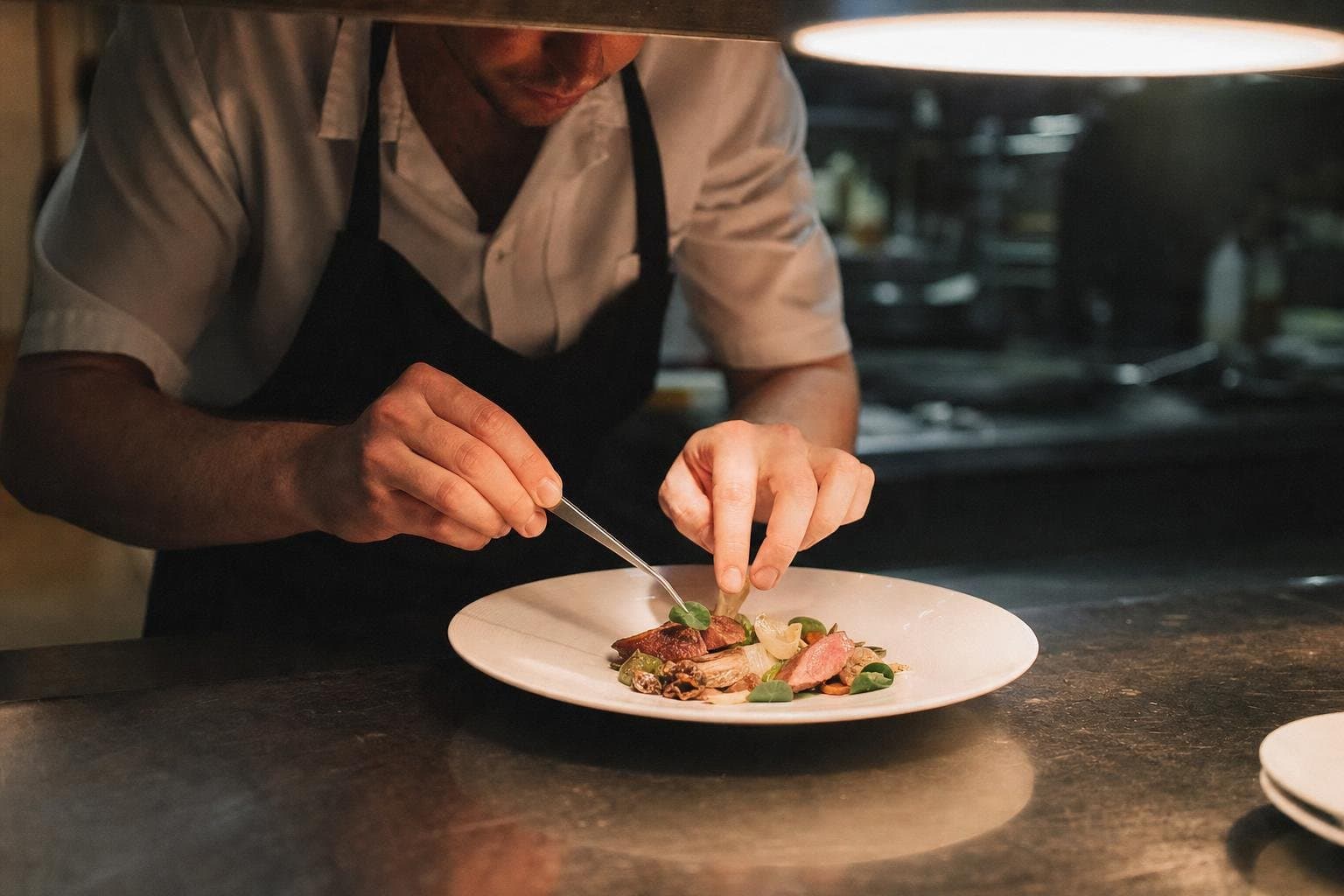
A fast-casual kitchen controls food cost by the case; a fine dining kitchen controls it by the gram. Your basket is dominated by ingredients that are expensive, seasonal, and unforgiving: line-caught fish with a two-day window, foie gras, aged beef, heirloom produce, imported cheese. When the median full-service food cost is 32.0% / 32.4% of sales and net margin is 3-5% net margin, a five-point swing on a $180 tasting menu is the whole profit on the table.
The classic monthly inventory count cannot govern that. By the time you discover on the 30th that yield on the halibut slipped, you have served it thirty times at a loss. AI does not replace the count. It shortens the loop between what you paid, what you plated, and what it cost, so the number you manage is today's, not last month's.
Connect invoices to recipes before you buy another tool
The foundation is boring, and it is where most of the money is: get every purveyor invoice into the system automatically and tie it to a costed recipe. MarginEdge and xtraCHEF use AI to read line items off the invoices your specialty suppliers send, so when the price of scallops jumps, the cost of every dish that uses them updates the same day. Apicbase and Restaurant365 hold the recipes themselves, down to trim yield and Mise en place, and recompute Food cost percentage and Prime cost as prices move. MarginEdge publishes flat pricing at $350 per location/month, which is legible against a single mis-ordered case of turbot.
Be honest about the limit: none of this counts the walk-in for you. Someone still has to weigh the fish on Tuesday. What the software removes is the manual transcription, the stale cost sheet, and the month-end surprise, not the discipline behind them.
Forecast to the reservation book
Fine dining has one advantage a QSR does not: you know who is coming. A near-full book, deposits, and a fixed menu make demand unusually predictable, and that is exactly what forecasting tools eat. Lineup.ai markets sales forecasts 35% more accurate, and 5-Out forecasts covers off your Point of sale (POS) and reservation data, so you order specialty items to the actual seat count rather than a gut feel.
52% inventory / 37% scheduling of operators plan to invest in inventory technology, and at your price point the payoff is concrete: order one fewer case of a $40-per-pound ingredient, or one more, and the Covers math either 86s a signature course early or throws it in the bin. Point the forecast at par levels for your most perishable, most expensive SKUs first. Those are the ones where being wrong by a day costs real money.
Waste is your biggest and least-watched line
At the top of the market, what you throw away is the most expensive food in the building. Trim from a whole fish, an over-prepped canape, a returned course, all of it is money, and it rarely shows up on any report. Winnow puts a camera and scale on the bin and uses AI to log what gets tossed; the company reports 50% waste cut and 2-8% food-cost savings, typically within a year, across 3,500+ sites, 94 countries.
For a kitchen prepping caviar service and butchering primal cuts in house, that curve is steeper than the average. The honest caveat is that waste hardware is an added cost and a habit change; it earns out only if the team actually scrapes into the tracked bin every service. Nationally, surplus food runs to 73.9M tons / $382B a year, and a fine dining kitchen sits at the expensive end of that number.
Questions fine dining restaurant operators ask
What does inventory and food cost software actually cost for a single fine dining room?
Will this make my kitchen feel corporate or slow down my chef?
We change the menu constantly. Does costing still work?
How accurate is AI forecasting when we serve a fixed number of covers a night?
What should we implement first?
References
Every figure on this page drills down.
15 sourced statistics cited here across 11 publications. Each number links to the research hub, and each entry there links out to its primary source.
- 01Restaurant365, What Is the Average Profit Margin for a Restaurant? (2024)
- 02National Restaurant Association, Restaurant operators kept food cost ratios in check in 2024 (2025)
- 03U.S. Bureau of Labor Statistics, Consumer Price Index: 2025 in review (2026)
- 04Blue Book Services (reporting Toast survey), The Toast 2025 Voice of the Restaurant Industry Survey Shows Operator Resilience (2025)
- 05ReFED, Food Waste Remains Stubbornly High Despite Signs of Progress, According to New ReFED Report (2025)
- 06National Restaurant Association, Persistent cost increases and enduring demand will shape the restaurant industry in 2026 (2026)
- 07Lineup.ai, Lineup.ai | AI Forecasting Software for Restaurants (2026)
- 08Winnow, Winnow: The Leading AI Food Waste Prevention System for Commercial Kitchens (2026)
- 09MarginEdge, Restaurant Invoicing Software Pricing (2026)
- 10National Restaurant Association, Where operators plan to invest in tech (2024)
- 11National Restaurant Association, Elevated labor costs had a significant impact on restaurant profitability in 2024 (2025)
Your next service / Ready when you are
Start with inventory & food cost for your fine dining restaurant
Turn what you have learned into a focused brief. Start with the job that matters most, and keep the tools that already work for your restaurant.
Describe it. Review it. Keep improving it. Check connections and costs before going live.