Food truck / Inventory & food cost
Inventory & food cost for food trucks
By the numbers
Source: National Restaurant Association
Source: National Restaurant Association
Source: National Restaurant Association
Source: National Restaurant Association
The food truck problem
How AI helps a food truck here
- Right-sizes one day's par, not a weekly order. Demand forecasting tools like Lineup.ai read your POS history and market its forecasts as 35% more accurate than gut-feel ordering, so you prep for the shift you are actually about to run.
- Forecasts by location, not by average. A Tuesday brewery lot and a Saturday festival are different businesses; AI can weight the forecast by the spot you posted, the day, and the weather instead of one blended number.
- Reads your prep from the POS you already carry. Square for Restaurants or Toast is the only sensor a lean truck has, and it already logs every sell and every sold-out moment (see Point of sale (POS)).
- Cuts the dump. Waste-tracking systems like Winnow report 2-8% food-cost savings within a year by making loss visible; on a truck the same instinct means fewer proteins prepped past demand.
- Reconciles invoices without a back office. MarginEdge and xtraCHEF scan supplier invoices and flag when your ground beef or masa price jumped, so Food cost percentage creep does not go unnoticed for a month.
- Times the close. AI reading historical sales told one operator to open later and save $4,000 saved; the same read tells a truck when the last hour never pays for the product you keep hot for it.
TableMagic for the shift, not the week
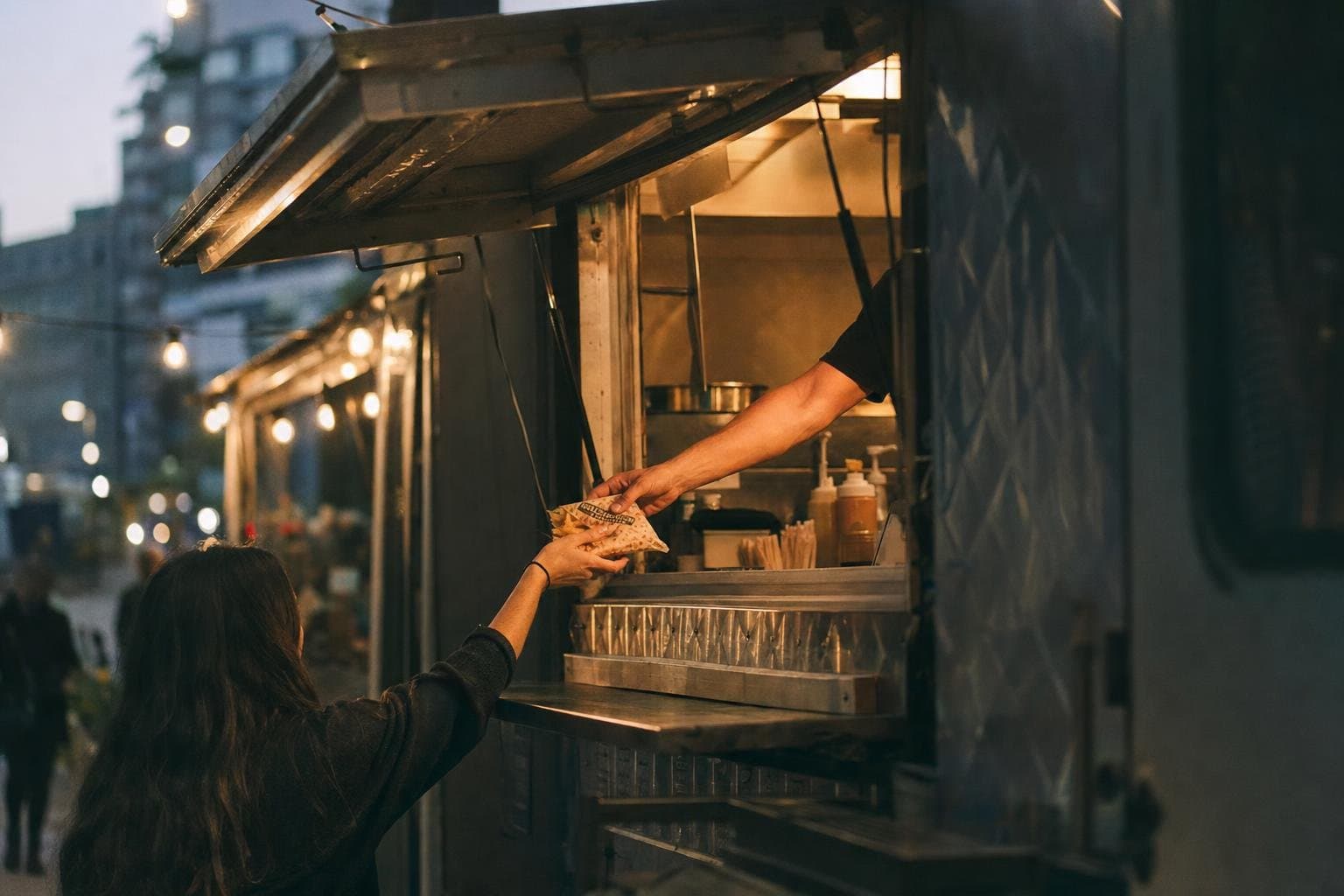
A truck has no dry storage worth planning around and no second service to absorb a miss. You prep once, roll to a spot, and sell until you sell out or until the crowd thins. That makes Demand forecasting the single highest-value place to point AI, because the cost of being wrong is symmetric and immediate: sell out an hour early and you turned away paying customers who drove to find you; over-prep and you eat the 32.0% / 32.4% of sales on everything that comes home.
The practical move is to let a forecasting layer read your Point of sale (POS) history and produce a par for tomorrow's specific spot. Lineup.ai is built exactly for this and markets 35% more accurate; the same pattern that improved pastry ordering for a large coffee chain by 8% accuracy gain applies to a truck's proteins and tortillas. The honest limit: a forecast is only as good as your history, so the first month is calibration, not magic. Log sell-outs deliberately (an 86 is a data point, see 86 (to 86 an item)), because a day you sold out at noon looks like a low-sales day to a naive model and quietly teaches it to under-prep you.
Your POS is the only back office you get
A truck's tech stack has to be one device deep. You are not running Crunchtime or a full Restaurant365 P&L engine from the service window; those are built for multi-unit operators and the overhead would swamp a solo truck. Be honest about that. What fits is a mobile-first POS that already captures every transaction, and a thin layer on top of it.
Square for Restaurants is the common spine for exactly this reason, and Toast is the heavier all-in-one alternative if you are scaling to multiple trucks. On top of that, invoice-scanning like xtraCHEF or MarginEdge (flat $350 per location/month) turns the pile of supplier receipts in your glovebox into a running food-cost number without a bookkeeper. The point is not to bolt on five tools: it is to make the one device you already carry tell you your Prime cost before it is a surprise at tax time.
- Start with the POS you run the window on; add forecasting before you add anything else.
- Use invoice AI to catch supplier price jumps, the +4.1% in 2025 pressure hits a truck's short list of core ingredients hardest.
- Skip enterprise inventory suites (Crunchtime, heavy Apicbase deployments) until you run more than one truck; they solve a problem you do not have yet.
- Treat 5-Out or Lineup.ai as the forecasting brain, not another dashboard to babysit.
Turn the location post into a demand signal
A truck's discovery is social and location-driven: word of mouth is still how 38% word of mouth / 16% search of guests find a new spot, and for a truck that word travels the day you post where you will be. That announcement is not just marketing, it is your best demand instrument. When people react, save, and reply to today's location, you have a leading indicator of the crowd before you prep it.
The lean version does not need a data science team. Read the engagement on the post, cross it against what that spot did last time in your POS, and adjust the par up or down. A following that chases the truck also lets you de-risk the tail of prep: pre-orders and a heads-up on the day's special convert your most loyal First-party data into committed covers, which is prep you can make with zero waste risk. AI-native operator tools like Owner.com can help run those announcement-and-promo loops so the marketing and the demand read are one motion, not two jobs you do at a red light.
Measure the dump, then close the gap
The number a truck almost never tracks is what came home. Full kitchens are adopting waste tracking because it works: Winnow reports 2-8% food-cost savings and up to a 50% waste cut by simply making loss visible and habitual. A truck will not install a camera-over-the-bin system, but the discipline transfers. Weigh or count what you dump at close for two weeks and you will find your real over-prep pattern, usually one or two items you keep making because running out of them feels worse than eating them.
Feed that back into the forecast and the loop closes: prep to demand, log the sell-outs and the dumps, and let the model tighten. This is where the ROI lives for a truck, because 52% inventory / 37% scheduling of operators are already investing in inventory tech and the reason is plain, cutting even a few points of a 32.0% / 32.4% of sales food cost drops straight to a 3-5% net margin bottom line. For the full framework across formats, see the general inventory and food cost capability guide, browse the inventory tools that fit a lean operation, and check the research behind these figures.
Questions food truck operators ask
I run the whole truck myself. Is forecasting AI actually worth the setup time?
What does this cost, and when does it pay off?
How do I avoid selling out too early without over-prepping?
Which tools are overkill for a food truck?
Does my location announcement really help me prep better?
References
Every figure on this page drills down.
16 sourced statistics cited here across 13 publications. Each number links to the research hub, and each entry there links out to its primary source.
- 01Restaurant365, What Is the Average Profit Margin for a Restaurant? (2024)
- 02National Restaurant Association, Restaurant operators kept food cost ratios in check in 2024 (2025)
- 03U.S. Bureau of Labor Statistics, Consumer Price Index: 2025 in review (2026)
- 04ReFED, Food Waste Remains Stubbornly High Despite Signs of Progress, According to New ReFED Report (2025)
- 05Blue Book Services (reporting Toast survey), The Toast 2025 Voice of the Restaurant Industry Survey Shows Operator Resilience (2025)
- 06Lineup.ai, Lineup.ai | AI Forecasting Software for Restaurants (2026)
- 07Winnow, Winnow: The Leading AI Food Waste Prevention System for Commercial Kitchens (2026)
- 08Restaurant Technology (Shawn Walchef, Cali BBQ) on Substack, The Future of Tech is Agentic: How Toast IQ Saved Us $4,000 (2025)
- 09Provectus, Reducing Food Waste Across 100+ Cafes with AI Demand Forecasting (2024)
- 10MarginEdge, Restaurant Invoicing Software Pricing (2026)
- 11PMQ Pizza (Toast survey data), How Are Guests Discovering New Restaurants? This National Survey Has Answers (2025)
- 12National Restaurant Association, Where operators plan to invest in tech (2024)
- 13National Restaurant Association, Elevated labor costs had a significant impact on restaurant profitability in 2024 (2025)
Your next service / Ready when you are
Start with inventory & food cost for your food truck
Turn what you have learned into a focused brief. Start with the job that matters most, and keep the tools that already work for your restaurant.
Describe it. Review it. Keep improving it. Check connections and costs before going live.