Food truck / Online ordering
Online ordering for food trucks
By the numbers
Source: National Restaurant Association
Source: National Restaurant Association
Source: National Restaurant Association
Source: National Restaurant Association
The food truck problem
How AI helps a food truck here
- Turns today's parking spot into an orderable menu: a First-party ordering link tied to the day's location and a cutoff time, so guests pre-pay and skip the line instead of walking away from it.
- Forecasts one day's prep from your own Point of sale (POS) history plus the day, spot, and weather, so Demand forecasting replaces the cook-and-pray call. Tools like Lineup.ai market forecasts 35% more accurate than traditional methods.
- Drafts and schedules the daily we-are-at-5th-and-Main-until-2 announcement across Instagram, a text blast, and your ordering page from one prompt, feeding the location-driven discovery a truck cannot skip (38% word of mouth / 16% search).
- Captures every online order as First-party data (a phone, an order history, a favorite) so you own a following that chases the truck, not a marketplace's anonymous demand.
- Auto-texts pickup-ready alerts and next-stop reminders. 81% have opted in to business texts and ~50% prefer restaurant texts, and 42% expect reply in 15 min / 66% within 1 hour.
- Flags when to 86 (to 86 an item) an item on the live page the moment prep runs low, so the truck stops selling what the window can no longer make.
Online ordering for a truck is pre-order, not delivery
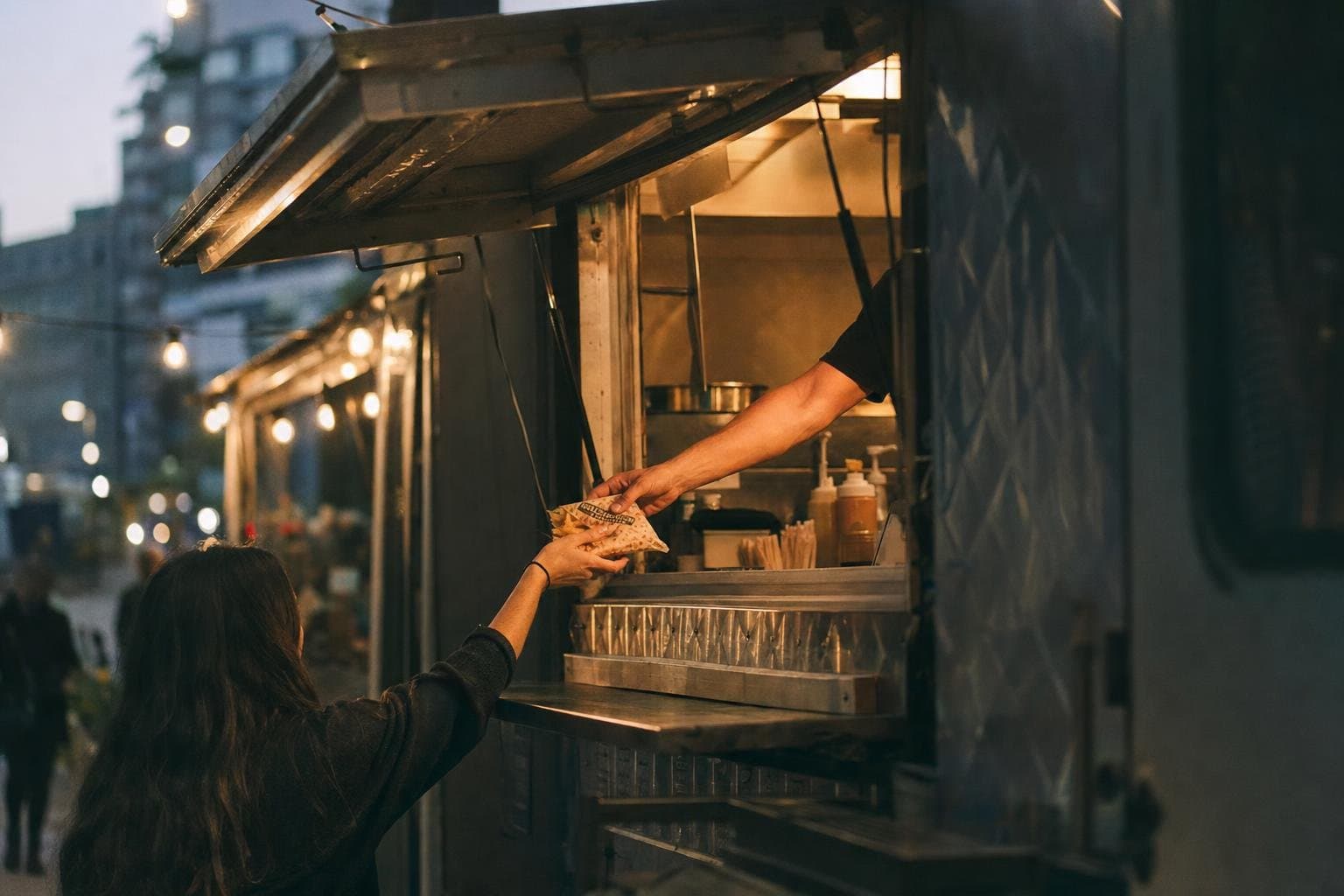
Forget the delivery model for a second. A truck's version of online ordering is ahead-of-line pickup pinned to wherever you are parked that day. The guest orders from their desk at 11:45, pays, and walks up to a side window at 12:15 while the walk-up line is 20-deep. That matters because 94% of consumers say speed is critical to their off-premises experience, and the one thing a truck cannot manufacture during a 90-minute lunch rush is more speed at the window. Pre-orders let you bank tickets before the rush even starts and cook against a real number instead of the crowd's mood.
The mechanic that makes this work is a location-aware ordering page: an AI can flip your First-party ordering link to today's pin, set the pickup window, and close ordering automatically when your prep count for an item hits zero. That is the honest limit of the big marketplaces here. DoorDash for Merchants and Uber Eats for Merchants assume a street address that does not move, so a truck fighting a daily address change is better served by a first-party stack from ChowNow, Square for Restaurants, or Owner.com, where you control the location field and keep the Third-party delivery commission off a ticket that cannot afford it.
Right-sizing the day: forecast, then cook to it
The prep call is the whole game. Sell out at 1pm and you left money and regulars on the sidewalk; over-prep and you are throwing away food you paid full price for, the plate-waste problem that costs U.S. consumers close to 35M tons / $261B a year. A solo operator has been making that call on gut and yesterday's weather. AI Demand forecasting does it from your actual sales: it reads how a Friday at the brewery differs from a Tuesday at the office park, factors rain and a nearby event, and hands you a par to prep against before you load the truck.
Pre-orders sharpen this into something a restaurant with a dining room never gets: firm demand hours ahead. Every ticket that lands before you fire the grill is a known quantity, so your day splits into committed volume plus a forecasted walk-up estimate, and your prep list writes itself. When an item's committed count runs down, the same system 86es it on the live page so you never sell a taco the window cannot make. That protects both your Food cost percentage and the regular who drove across town for the one thing you ran out of.
- Feed the forecast your Point of sale (POS) export, not a spreadsheet you maintain by hand: Square for Restaurants and Toast already hold the history the model needs.
- Treat pre-orders as your floor and the forecast as the ceiling, then prep to the middle and adjust as the cutoff approaches.
- Log actual sold-out times so next month's forecast learns which spots consistently beat the par.
Build a following that chases the truck
A brick-and-mortar can rely on foot traffic; a truck has to be found new every single day, and discovery is overwhelmingly social and word-of-mouth (38% word of mouth / 16% search). The asset that makes a truck durable is a list of people who want to know where you will be, and online ordering is how you build it, because everyone who orders hands you a phone number and a name. That is First-party data you own, and it converts far better than borrowed reach: first-party ordering guests attach to loyalty at 41% vs 3% than marketplace guests.
From there an AI runs the daily loop that a solo operator has no time for: it writes the location post, fires a text to the neighborhood you are parked in that day, and reminds last week's regulars you are back. SMS is the right channel for a truck because it is immediate and time-sensitive: 81% have opted in to business texts, and 42% expect reply in 15 min / 66% within 1 hour. A same-day text saying we are here until 2, order ahead here is the single highest-leverage message a truck can send, and 81% of people say they would join a loyalty program at a favorite spot if offered one. Keep it honest and opt-in through Klaviyo or your ordering platform's built-in messaging, and only ever text from a real number people signed up for.
Questions food truck operators ask
Is online ordering worth it if I only serve a few hours at each stop?
Should I be on DoorDash and Uber Eats?
What does this actually cost a one-person truck?
Will my Google listing help if my location changes every day?
How do I avoid selling out of my bestseller by 1pm?
References
Every figure on this page drills down.
17 sourced statistics cited here across 13 publications. Each number links to the research hub, and each entry there links out to its primary source.
- 01National Restaurant Association, From Trend to Transformation: Off-Premises Dining Now Essential (2025)
- 02National Restaurant Association, Restaurant operators kept food cost ratios in check in 2024 (2025)
- 03Restaurant365, What Is the Average Profit Margin for a Restaurant? (2024)
- 04Sauce (getsauce.com), Breaking Down DoorDash Fees For Restaurants (2024)
- 05Rezku, Third-Party Delivery Fees in 2026: What DoorDash, Uber Eats & Grubhub Really Cost Restaurants (2026)
- 06Lineup.ai, Lineup.ai | AI Forecasting Software for Restaurants (2026)
- 07PMQ Pizza (Toast survey data), How Are Guests Discovering New Restaurants? This National Survey Has Answers (2025)
- 08EZ Texting, 2024 SMS Marketing Consumer Behavior Report (2024)
- 09SevenRooms, Improving Your Restaurant Waitlist Management with a Virtual Waitlist (2024)
- 10ReFED, Food Waste Remains Stubbornly High Despite Signs of Progress, According to New ReFED Report (2025)
- 11Paytronix, Online Ordering 2024 Trends: Converting Guests from Third- to First-Party (2024)
- 12National Restaurant Association, Get with the program: Building loyalty grows business (2024)
- 13Owner.com, Online Ordering and Restaurant Marketing System (2026)
Your next service / Ready when you are
Start with online ordering for your food truck
Turn what you have learned into a focused brief. Start with the job that matters most, and keep the tools that already work for your restaurant.
Describe it. Review it. Keep improving it. Check connections and costs before going live.