Ghost kitchen / Demand forecasting
Demand forecasting for ghost kitchens and delivery-only brands
By the numbers
Source: National Restaurant Association
Source: National Restaurant Association
Source: National Restaurant Association
Source: National Restaurant Association
The ghost kitchen problem
How AI helps a ghost kitchen here
- Forecast per channel, then in aggregate: an AI model separates demand on Uber Eats for Merchants from your own First-party ordering app so one line preps to the combined curve, not three separate guesses. Vendors market accuracy gains like 35% more accurate.
- TableMagic by virtual brand: run several concept menus off one line and get a station-level prep list per brand for each daypart.
- Cut waste on shared ingredients: because virtual brands draw on a common pantry, tighter forecasts compound. Winnow reports food-cost savings of 2-8% food-cost savings.
- Staff to the actual demand, not a hunch: labor forecasting integrated with the POS is marketed as 55,000 restaurants / 1.5M workers.
- Time promos to capacity: know whether a marketplace promo will swamp the line before you accept it.
- Shift volume toward first-party: forecasting your own channel confidently is what makes owning the customer safe, and first-party guests attach to loyalty at 41% vs 3%.
One kitchen, several order streams, one forecast
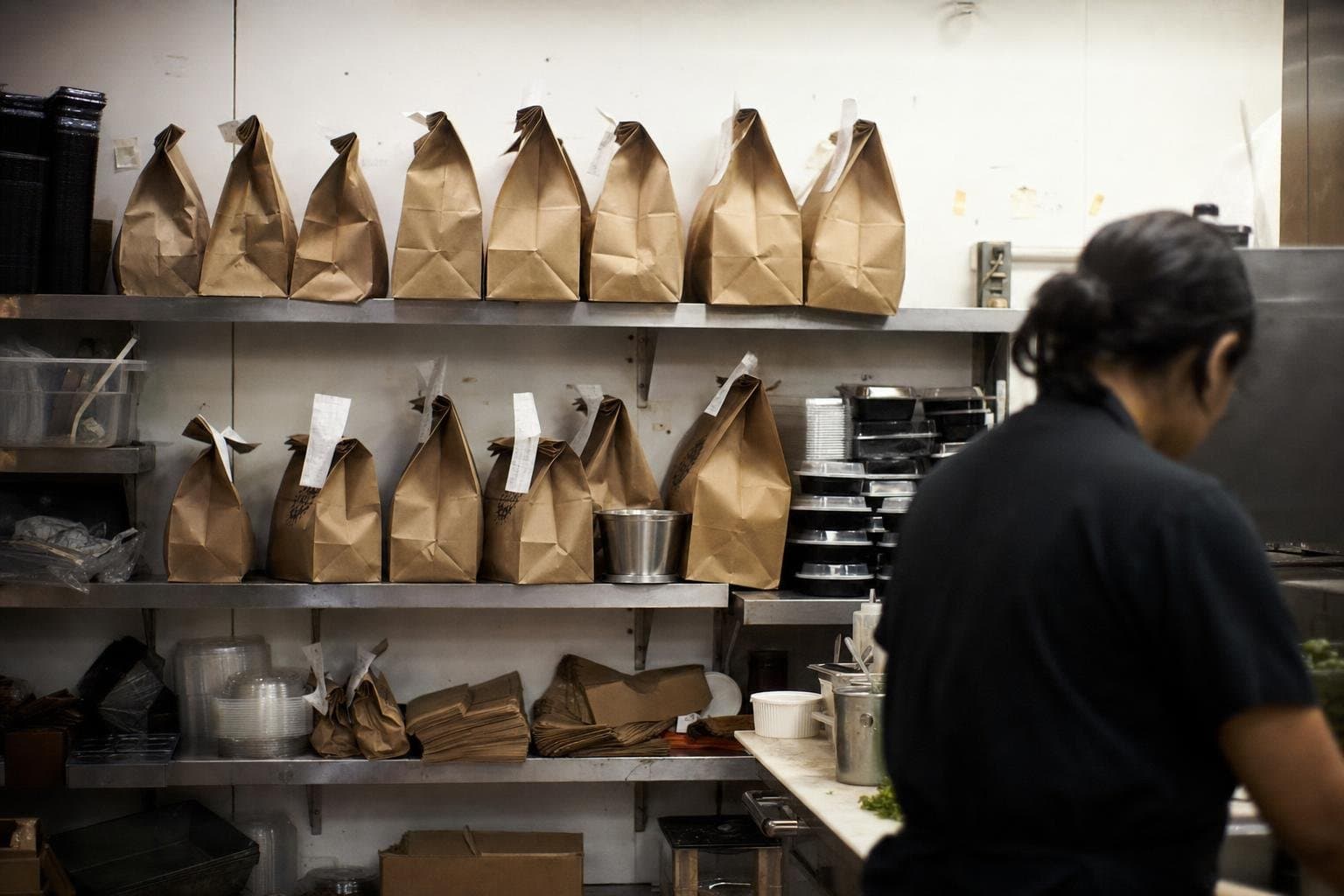
A dining room hands an operator a hundred small signals: the reservation book, the walk-in line, the weather outside the window. A Ghost kitchen has none of them. Demand arrives as digital tickets across DoorDash for Merchants, Uber Eats for Merchants, and your own site, and each marketplace runs its own promotions, delivery-radius throttling, and peak. This is the delivery-only version of demand forecasting: the model pulls every channel into one projection and forecasts the combined order curve by daypart, so the line preps once to the total instead of three times to three hunches. Tools such as Lineup.ai and 5-Out build these projections from POS history.
The forecast is only as good as the data feeding it, and a ghost kitchen's data is scattered across tablets. Order-aggregation layers like Checkmate and Olo consolidate every channel's tickets into a single POS stream, which is the clean history a forecast needs. With that in place, the 94% of consumers who say speed defines their off-premise experience become reachable, because you prep ahead of the curve instead of scrambling when three apps spike together.
Multiple virtual brands, one shared pantry
The economic trick of a ghost kitchen is running several virtual brands off a single line: a burger concept, a wings concept, and a salad concept all cooking out of the same walk-in. That multiplies the forecasting problem, because each brand has its own demand pattern and its own hero items while they all draw on a shared Mise en place. An AI forecast that projects per brand and per daypart lets you build one consolidated prep list where shared ingredients (proteins, bases, sauces) are batched once to the combined need, which is exactly where waste collapses. Winnow reports waste cuts up to 50% waste cut from catching what the forecast missed, and food runs a median of 32.0% / 32.4% of sales before any of that.
- Project each virtual brand separately, then batch shared prep to the sum.
- Weight the forecast with Menu engineering so high-margin heroes drive the prep, not just the loudest promo.
- Pause or kill a virtual brand quickly when its channel demand never materializes.
Forecast your own app to own the customer
Every marketplace order is rented demand: you pay 30%-40% of revenue and you never learn who the customer is. The strategic move for a delivery-only brand is to shift volume onto First-party ordering, where you keep the margin and the First-party data. It matters because first-party guests attach to loyalty at 41% vs 3% versus marketplace guests, and operators moving delivery in-house report real savings, such as $31,000 fees saved in avoided fees for one brand. Forecasting is what makes the shift safe: once you can project your own app's demand as confidently as the marketplaces', you can staff, prep, and run promos for direct orders without fear of an 86 (to 86 an item).
The stack for this includes Owner.com and ChowNow for first-party ordering and Lunchbox for delivery-brand storefronts, while POS-native forecasting inside Toast or a full-P&L engine like Restaurant365 ties the projection to food and labor cost (compare options on our tools list). Be honest about the limit: a brand-new virtual concept has no history, so its first weeks are a cold start where the model guesses wide. Feed it fast with a few weeks of real orders, keep a human eye on any promo-distorted spike, and remember the marketplaces keep their slice of the customer data, so your own channel is the only place the forecast gets to learn who is actually buying.
Questions ghost kitchens and delivery-only brand operators ask
What does AI demand forecasting cost for a delivery-only brand, and does it pay off?
Can one model forecast several virtual brands running off the same line?
Will forecasting actually help me get off the delivery apps?
How much order history do I need before the forecast is trustworthy?
References
Every figure on this page drills down.
18 sourced statistics cited here across 14 publications. Each number links to the research hub, and each entry there links out to its primary source.
- 01Sauce (getsauce.com), Breaking Down DoorDash Fees For Restaurants (2024)
- 02Rezku, Third-Party Delivery Fees in 2026: What DoorDash, Uber Eats & Grubhub Really Cost Restaurants (2026)
- 03National Restaurant Association, From Trend to Transformation: Off-Premises Dining Now Essential (2025)
- 04Restaurant365, What Is the Average Profit Margin for a Restaurant? (2024)
- 05Statista, Online Food Delivery - United States | Market Forecast (2026)
- 06Lineup.ai, Lineup.ai | AI Forecasting Software for Restaurants (2026)
- 07Winnow, Winnow: The Leading AI Food Waste Prevention System for Commercial Kitchens (2026)
- 087shifts, AI Information Page for 7shifts (2026)
- 09Paytronix, Online Ordering 2024 Trends: Converting Guests from Third- to First-Party (2024)
- 10National Restaurant Association, Restaurant operators kept food cost ratios in check in 2024 (2025)
- 11Owner.com, Online Ordering and Restaurant Marketing System (2026)
- 12MarginEdge, Restaurant Invoicing Software Pricing (2026)
- 13Restaurant Technology (Shawn Walchef, Cali BBQ) on Substack, The Future of Tech is Agentic: How Toast IQ Saved Us $4,000 (2025)
- 14National Restaurant Association, Elevated labor costs had a significant impact on restaurant profitability in 2024 (2025)
Your next service / Ready when you are
Start with demand forecasting for your ghost kitchen
Turn what you have learned into a focused brief. Start with the job that matters most, and keep the tools that already work for your restaurant.
Describe it. Review it. Keep improving it. Check connections and costs before going live.