Pizzeria / Demand forecasting
Demand forecasting for pizzerias
By the numbers
Source: National Restaurant Association
Source: National Restaurant Association
Source: National Restaurant Association
Source: National Restaurant Association
The pizzeria problem
How AI helps a pizzeria here
- Turns your last two years of tickets into a daily prep sheet: predicted dough-ball counts, shred weights, and sauce batches per day-part, so Mise en place matches the night instead of a hunch. Tools like Lineup.ai market forecasts 35% more accurate than manual methods.
- Forecasts the Friday and Saturday phone spike hour by hour, so you know when to add a phone person or route overflow to a voice agent before 40% unanswered / $20B lost annually of your calls quietly go unanswered.
- Predicts the pickup-versus-delivery split for the shift, so you staff the right number of drivers instead of paying idle ones or missing quoted times.
- Feeds labor scheduling directly: 7shifts markets POS-integrated forecasting it calls 95% accurate, which for a thin family crew means covering the rush without stacking hours you did not need.
- Cuts prep waste at the source. AI food-waste tracking like Winnow reports cutting kitchen waste by 50% waste cut and food cost by 2-8% food-cost savings.
- Flags the events, paydays, and weather swings that move pizza demand, the exact signals a family operator cannot watch while working the line.
The daily dough math is a forecasting problem, not a habit
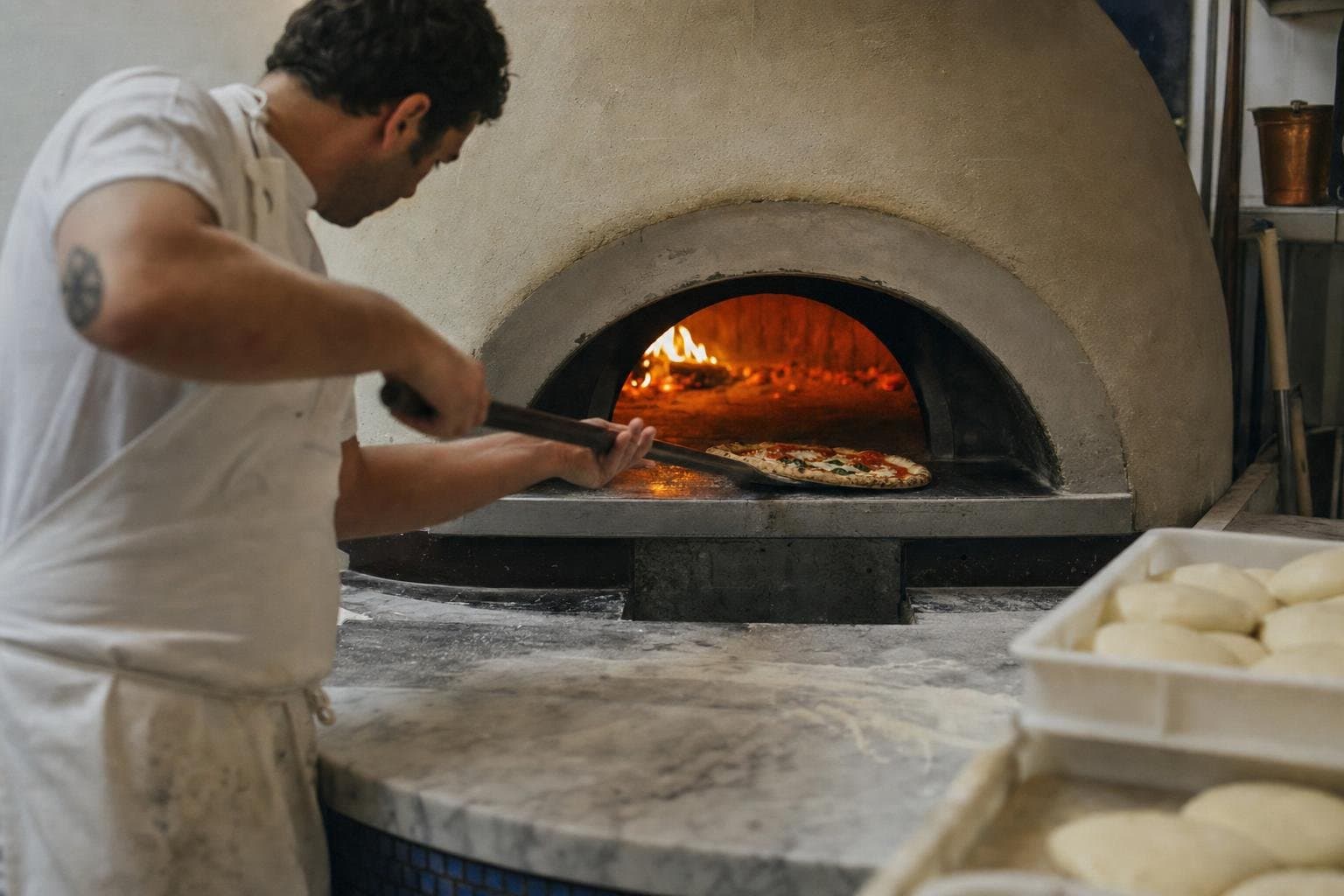
Dough is the one ingredient a pizzeria has to commit to before it knows the night. A 24 to 72 hour cold ferment means Thursday's ball count is really a bet on Saturday's orders, and a wrong bet costs you either a sold-out menu or a rack of flat, over-proofed dough you scrape into the bin. Traditional prep sheets copy last week forward, which quietly ignores the payday weekend, the local game, and the rain that keeps everyone home ordering delivery.
AI Demand forecasting replaces the copy-forward habit with a model trained on your own Point of sale (POS) history, broken down by day-part and channel. Platforms such as Lineup.ai and 5-Out pull directly from POS systems like Toast or Square for Restaurants and output an item-level prep number, not just a sales dollar figure. The analog is proven elsewhere: an AI demand forecast built for Blue Bottle's pastry program lifted ordering accuracy by 8% accuracy gain in its first month, cutting both overstock and stockouts, which is exactly the two-sided error a pizzeria fights every prep shift.
- Ball dough to a predicted count per fermentation batch, not a fixed daily number
- Right-size perishable topping prep (fresh mozz, basil, prepped veg) that cannot be re-shelved
- Cut the end-of-night 86 (to 86 an item) list that sends guests to a competitor
Forecasting the call spike, not just the food
A pizzeria's demand shows up on the phone first, and Friday and Saturday dinner is a wall of simultaneous calls a two-person counter cannot answer. Every missed ring is a delivery order that dials the shop down the street, and across the industry roughly 40% unanswered / $20B lost annually of restaurant calls go unanswered, an estimated $20 billion in lost revenue. Forecasting is what tells you the wall is coming at 6:45 and how tall it will be.
Once you can predict the phone curve, you can staff to it or absorb it with a voice agent. Slang.ai reports restaurants handle up to Up to 50% more phone covers / 96%+ satisfaction using its voice AI to catch overflow, which for a family shop means the calls you physically cannot reach during the rush still turn into tickets. The forecast and the phone plan are one decision: knowing the volume is what makes staffing or automating it a choice instead of a scramble.
Delivery-heavy demand and the commission trap
Forecasting demand is only half the win if the demand routes through channels that eat the margin. A delivery-forward pizzeria often sends a large share of volume through Third-party delivery, where plans run 15% / 25% / 30% and the all-in effective cost lands near 30%-40% of revenue once fees, refunds, and processing stack up. A good forecast tells you not just how many pizzas, but how many are coming through the channel that keeps almost nothing.
That visibility is the case for shifting volume to First-party ordering. Guests who order direct attach to loyalty at 41% vs 3% versus third-party marketplaces, and operators moving delivery in-house with Owner.com report real savings, one shop avoiding $31,000 fees saved in third-party fees. Forecasting your channel mix by day-part shows exactly where the leak is and which shifts are worth pushing your own online ordering and pickup. Be honest about the limit: a forecast reshapes demand you can influence, it does not force a marketplace regular to switch, and driver capacity and quoted delivery times are still yours to manage.
Thin crews, and letting the model do the mental math
A family-run pizzeria does not have a back-office analyst; the owner is on the oven. That is precisely why an automated forecast pays for itself, because the alternative is a tired operator eyeballing next week at 11pm. Independent operator Cali BBQ used AI to analyze historical sales and saved $4,000 saved in unnecessary labor from a single scheduling decision the AI produced in under a minute.
Wire the forecast into labor and inventory so it becomes a working document, not a report nobody reads. 7shifts builds schedules off the POS-driven forecast, and MarginEdge (flat $350 per location/month) or Restaurant365 turn the same demand signal into order guides and live food cost against your Prime cost. The point for a short-staffed shop is not a dashboard to admire, it is one fewer thing the owner has to hold in their head while the tickets pile up.
Questions pizzeria operators ask
How much does demand forecasting actually cost a small pizzeria?
I have decades of gut feel. Will a model really beat me?
How much order history do I need before it works?
Can it forecast delivery separately from pickup and dine-in?
Does it handle the Friday and Saturday phone crush?
References
Every figure on this page drills down.
19 sourced statistics cited here across 16 publications. Each number links to the research hub, and each entry there links out to its primary source.
- 01National Restaurant Association, From Trend to Transformation: Off-Premises Dining Now Essential (2025)
- 02Restaurant365, What Is the Average Profit Margin for a Restaurant? (2024)
- 03National Restaurant Association, Restaurant operators kept food cost ratios in check in 2024 (2025)
- 04National Restaurant Association, Elevated labor costs had a significant impact on restaurant profitability in 2024 (2025)
- 05U.S. Bureau of Labor Statistics, Consumer Price Index: 2025 in review (2026)
- 06Rezku, Third-Party Delivery Fees in 2026: What DoorDash, Uber Eats & Grubhub Really Cost Restaurants (2026)
- 07Lineup.ai, Lineup.ai | AI Forecasting Software for Restaurants (2026)
- 08Nation's Restaurant News, The disappearing front of house: How AI fills the gap when good people are hard to find (2025)
- 09Winnow, Winnow: The Leading AI Food Waste Prevention System for Commercial Kitchens (2026)
- 10Provectus, Reducing Food Waste Across 100+ Cafes with AI Demand Forecasting (2024)
- 11Slang AI, Slang AI homepage (2026)
- 12Sauce (getsauce.com), Breaking Down DoorDash Fees For Restaurants (2024)
- 13Paytronix, Online Ordering 2024 Trends: Converting Guests from Third- to First-Party (2024)
- 14Owner.com, Online Ordering and Restaurant Marketing System (2026)
- 15Restaurant Technology (Shawn Walchef, Cali BBQ) on Substack, The Future of Tech is Agentic: How Toast IQ Saved Us $4,000 (2025)
- 16MarginEdge, Restaurant Invoicing Software Pricing (2026)
Your next service / Ready when you are
Start with demand forecasting for your pizzeria
Turn what you have learned into a focused brief. Start with the job that matters most, and keep the tools that already work for your restaurant.
Describe it. Review it. Keep improving it. Check connections and costs before going live.