Ghost kitchen / Reservations & no-shows
Reservations & no-shows for ghost kitchens and delivery-only brands
By the numbers
Source: Nation's Restaurant News
Source: Restaurant Dive
Source: Toast (via The Globe and Mail)
Source: Toast (via The Globe and Mail)
The ghost kitchen problem
How AI helps a ghost kitchen here
- Answer every direct-order call. Voice AI phone agents (Slang.ai, Loman AI, Bland AI) take orders and quote honest prep times so a rush never hands a paying guest to a competitor's app, recovering some of the 40% of calls that go unanswered 40% unanswered / $20B lost annually.
- Confirm and de-risk each ticket by text. 81% of consumers have opted into business texts 81% have opted in to business texts and 42% expect a reply within 15 minutes 42% expect reply in 15 min / 66% within 1 hour, so automated SMS confirmation and prep-time updates cut the cancellations and refund disputes that eat delivery margin.
- Forecast combined demand across channels and brands. Demand forecasting tools like Lineup.ai (marketed as 35% more accurate than traditional methods 35% more accurate) and 5-Out predict covers and item mix by daypart so you prep one line against all apps at once.
- Convert rented demand into owned demand. Standing up First-party ordering with Owner.com or ChowNow lets AI route repeat guests to your direct channel, where guests attach to loyalty at 41% versus 3% off a marketplace 41% vs 3%.
- Unify one guest across every brand and app. A Customer data platform (CDP) such as Bikky or aggregator like Checkmate merges scattered order feeds into one guest record for win-back and lifetime-value work.
- Run AI win-back to repeat. 74% of guests return after a good experience, and diners are 3.5x more likely to return after email 74% return after a unique experience.
Your reservation book is a demand forecast across every channel
In a delivery-only brand there is no host stand and no booking. The scarce resource you actually schedule is kitchen capacity against demand that arrives on three or four apps at once, plus your direct channel, often for several virtual brands out of one line. That is the ghost-kitchen version of the reservation book: a rolling Demand forecasting you have to get right by daypart, or you either 86 (to 86 an item) items mid-rush or prep food that never sells.
With off-premise now a larger share of sales for 58% of limited-service operators than in 2019 58% LS / 41% FS and 94% of consumers calling speed critical to the off-premise experience 94%, the forecast is the operation. AI tools like Lineup.ai and 5-Out pull historical order data by channel and by brand and predict covers and item mix by hour, so you prep and staff one line against combined demand instead of guessing app by app.
- Forecast by virtual brand, not just by store total
- Consolidate DoorDash, Uber Eats, and direct order history into one prep number
- Drive staffing and 86 decisions from predicted item mix, not yesterday's gut
Your no-show is a missed call and a cancelled order
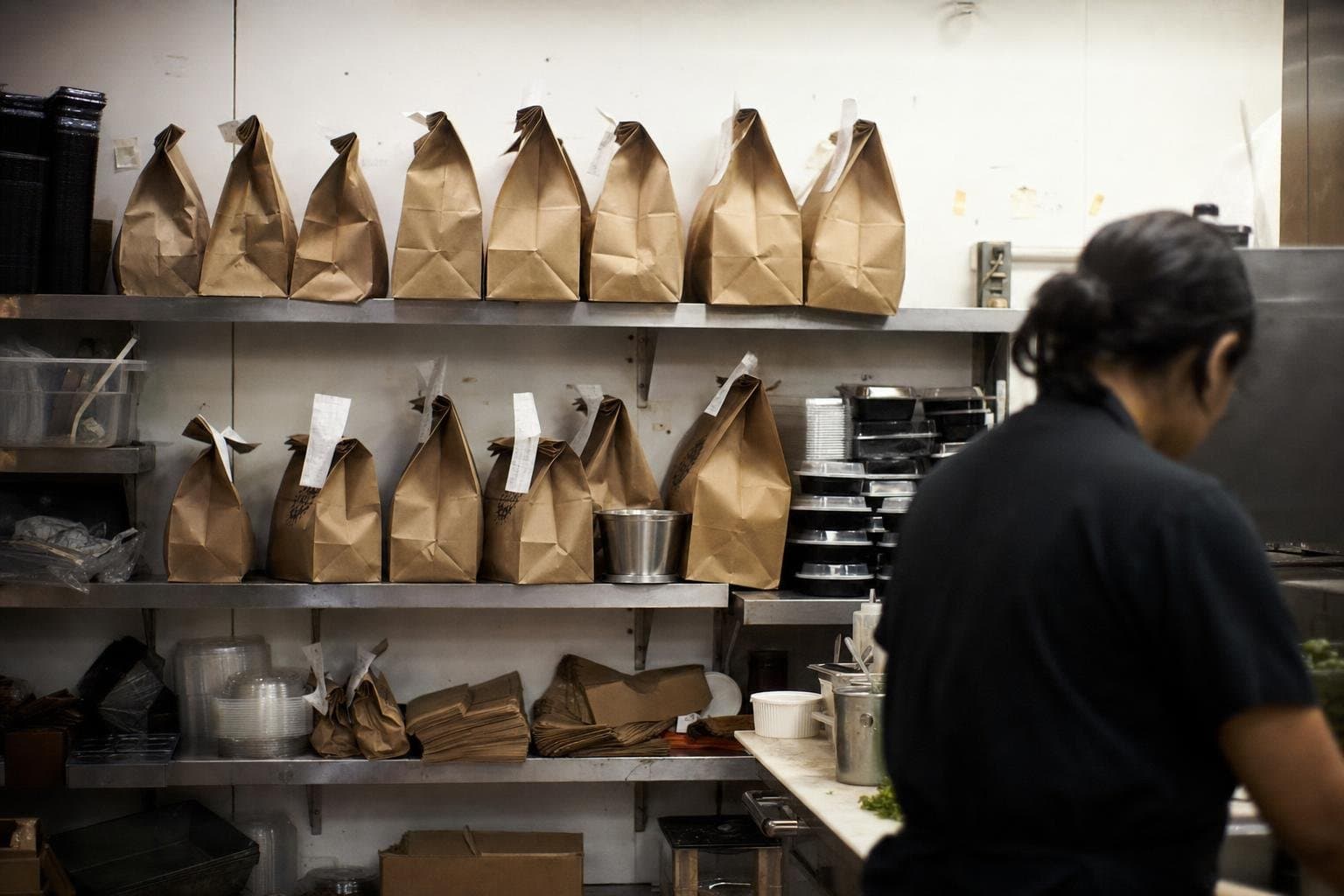
A No-show in a dining room is an empty table. In a delivery-only brand the equivalent is revenue that never lands: the direct-order call nobody answered, the checkout a guest abandons, the ticket that cancels because prep time blew past the quote. About 40% of restaurant phone calls go unanswered, an estimated $20 billion in lost revenue a year 40% unanswered / $20B lost annually.
Voice AI phone agents like Slang.ai, Loman AI, and Bland AI answer every direct-order call, take the order, and quote an honest time, so a rush never routes a paying guest to a competitor's marketplace. On the confirmation side, nearly half of Americans prefer receiving texts from restaurants ~50% prefer restaurant texts, so automated SMS that confirms the order and updates prep time is exactly the channel guests want, and it cuts the cancellations and refund disputes that quietly drain a delivery brand's thin margin.
Own the customer, or rent them at thirty cents on the dollar
This is the strategic core of a delivery-only brand. Because third-party commissions run 15% to 30% 15% / 25% / 30% and the all-in effective cost lands near 30% to 40% of revenue 30%-40% of revenue, every marketplace order is roughly a third of the ticket gone before food cost. Worse, the app owns the guest: First-party ordering guests attach to loyalty programs at 41%, versus just 3% for guests acquired through a marketplace 41% vs 3%.
Building a direct channel with Owner.com, ChowNow, or Lunchbox and then using AI to route repeat guests to it is how a delivery-only brand converts rented demand into owned First-party data. One operator moving delivery in-house reported $31,000 in third-party fees avoided $31,000 fees saved. That owned relationship is what raises Customer lifetime value (CLV) and lowers your dependence on any single app's algorithm.
- Stand up first-party ordering and make it the default on every insert, bag, and receipt
- Unify order history across apps into a CDP like Bikky so one guest is one record
- Run AI win-back to lapsed guests: 74% return after a good experience, 3.5x more after email 74% return after a unique experience
One kitchen, several brands, one guest database
Running multiple virtual brands from a single line multiplies the channels but not the staff, and that is exactly where AI earns its keep. Each brand may live on DoorDash, Uber Eats, and its own site, so one physical rush shows up as a dozen separate order feeds fighting for the same fryer.
Order-aggregation and Customer data platform (CDP) tools such as Checkmate and Bikky consolidate those feeds into one screen and one guest record, so AI can forecast combined load, recognize a repeat guest across brands, and show you which virtual concept actually earns its shelf space. Be honest about the limit: none of this fixes a concept with no demand or a menu that does not travel well. These tools sharpen a brand that already works. They do not invent one.
Questions ghost kitchens and delivery-only brand operators ask
Do reservations and no-show prevention even apply to a delivery-only brand?
What does AI phone ordering cost, and is it worth it for a ghost kitchen?
What is the real ROI of moving to first-party ordering?
How do I forecast when the same rush hits four apps and three brands at once?
Where should a delivery-only brand start?
References
Every figure on this page drills down.
20 sourced statistics cited here across 14 publications. Each number links to the research hub, and each entry there links out to its primary source.
- 01National Restaurant Association, From Trend to Transformation: Off-Premises Dining Now Essential (2025)
- 02Sauce (getsauce.com), Breaking Down DoorDash Fees For Restaurants (2024)
- 03Rezku, Third-Party Delivery Fees in 2026: What DoorDash, Uber Eats & Grubhub Really Cost Restaurants (2026)
- 04Restaurant365, What Is the Average Profit Margin for a Restaurant? (2024)
- 05Nation's Restaurant News, The disappearing front of house: How AI fills the gap when good people are hard to find (2025)
- 06EZ Texting, 2024 SMS Marketing Consumer Behavior Report (2024)
- 07Lineup.ai, Lineup.ai | AI Forecasting Software for Restaurants (2026)
- 08Paytronix, Online Ordering 2024 Trends: Converting Guests from Third- to First-Party (2024)
- 09SevenRooms, Improving Your Restaurant Waitlist Management with a Virtual Waitlist (2024)
- 10Owner.com, Online Ordering and Restaurant Marketing System (2026)
- 11Slang.ai, Slang AI Pricing | Restaurant Voice AI Plans (2026)
- 12Restaurant Dive, OpenTable launches initiative to combat diner no-shows (2024)
- 13Toast (via The Globe and Mail), Toast Data: How Reservation and Full-Service Restaurant Dining Trends Shifted In the Last Year (2025)
- 14The Philadelphia Inquirer, OpenTable begins adding a 2% service fee to some transactions, including no-show fees (2026)
Your next service / Ready when you are
Start with reservations & no-shows for your ghost kitchen
Turn what you have learned into a focused brief. Start with the job that matters most, and keep the tools that already work for your restaurant.
Describe it. Review it. Keep improving it. Check connections and costs before going live.