Ghost kitchen / AI phone answering
AI phone answering for ghost kitchens and delivery-only brands
By the numbers
Source: Nation's Restaurant News
Source: Restaurant Dive
Source: Toast (via The Globe and Mail)
Source: Toast (via The Globe and Mail)
The ghost kitchen problem
How AI helps a ghost kitchen here
- Answers every direct-order and catering call 24/7 so a first-party order never rolls to voicemail, capturing the margin a marketplace would otherwise tax at 30%-40% of revenue.
- Runs one agent across several virtual brands from a single kitchen, greeting each caller in the right brand voice based on the number they dialed.
- Pushes callers to your own ordering link (Owner.com, ChowNow), where guests attach to loyalty at 41% vs 3% versus near zero on marketplaces.
- Captures First-party data (name, phone, order history) on every call, the exact asset third-party apps keep hidden from you.
- Screens the driver-support calls and wrong numbers a delivery line attracts, so your cooks are not doubling as a switchboard.
- Upsells consistently on every order, the same context-specific Upselling that lifts direct check size without a distracted staffer.
Why the phone is your cheapest exit from commission
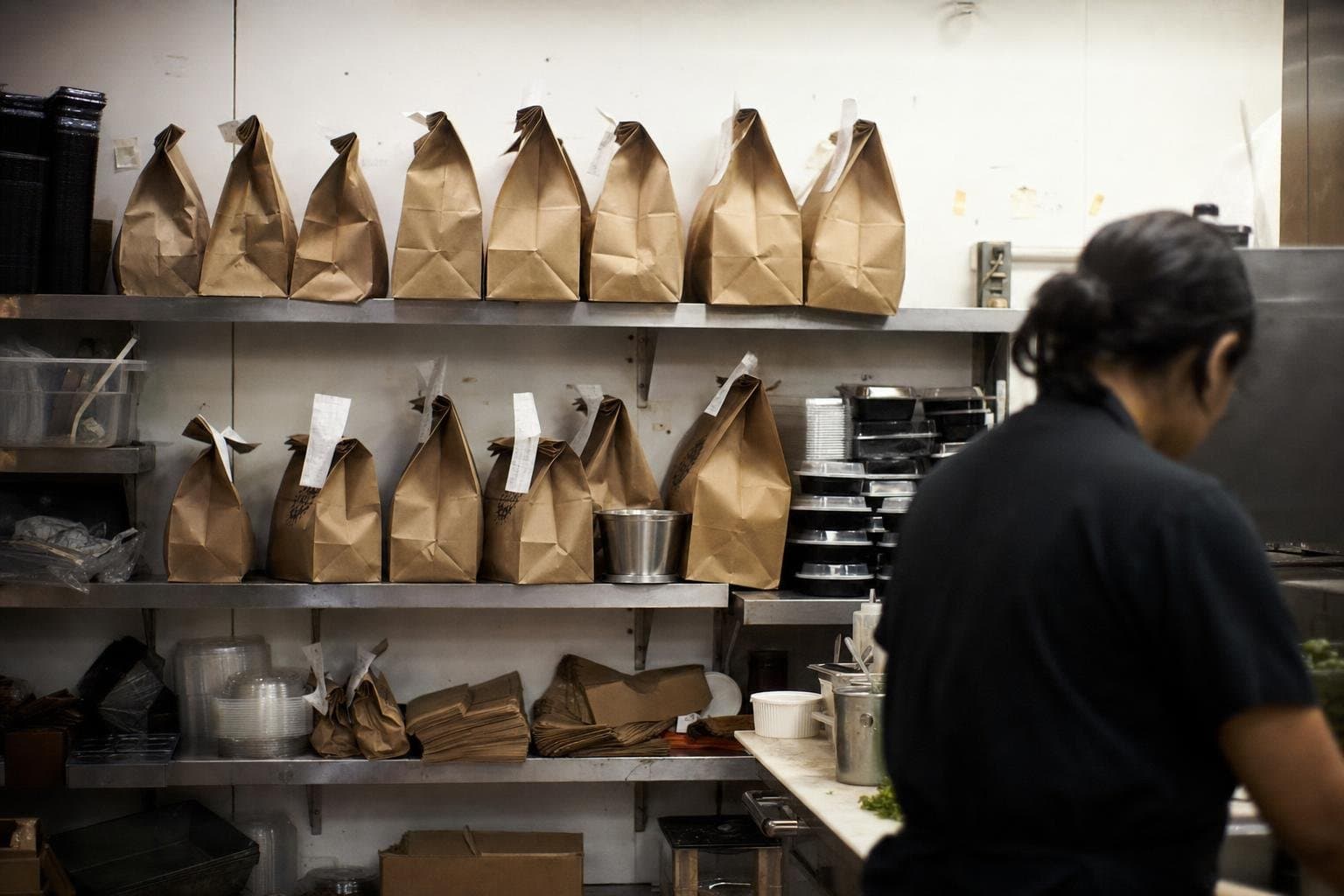
Every order a marketplace sends you arrives with a customer you do not own and a bill near 30%-40% of revenue. The strategic job of a delivery-only brand is to convert those rented guests into direct ones, and the phone is the one channel already printed on your bags, your Google listing, and your catering sheet. First-party ordering guests attach to loyalty programs at 41% vs 3%, and operators who shift volume direct report real fee savings (one brand avoided $31,000 fees saved in third-party fees).
A voice agent from Slang.ai, Loman AI, or Bland AI answers on the first ring, takes the order or texts back a direct ordering link, and records the First-party data you need to market again without paying a finder's fee twice. For a kitchen with no host to pick up, this is not a nice-to-have. It is the difference between a direct channel that exists on paper and one that actually converts.
One kitchen, several brands, one voice agent
A single Ghost kitchen often runs three or five virtual brands from the same hood, and each brand needs its own phone number and its own greeting. A voice agent routes by the number dialed, so a caller to your wings concept hears the wings concept and a caller to your poke concept hears the poke concept, all from one configuration. That is impossible to staff (you cannot ask a line cook to answer as five different restaurants in five different tones) and trivial for AI.
The agent also holds each brand's live menu independently, so it can 86 (to 86 an item) a sold-out item on one brand without touching the others, and quote the right Average check and prep time per concept. As you spin up or retire virtual brands, you update a config, not a training binder.
Forecast the phone alongside every delivery channel
A delivery brand lives or dies on prep accuracy across DoorDash, Uber Eats, and its own direct channel at once. Demand forecasting tools like Lineup.ai (marketed as 35% more accurate) and Datassential blend those streams so your kitchen preps to true combined demand rather than guessing per app. Direct phone and web orders are usually the blind spot in that forecast because they sit outside the marketplace dashboards.
Feeding voice-agent order volume back into the forecast (and into scheduling via a tool like 7shifts) closes that gap. It also protects the channel you most want to grow: nothing kills a fledgling direct-order habit faster than a guest who calls, gets through, and then hears the item is out.
What it costs, and where it still breaks
Pricing is transparent and modest against a single saved commission. Slang.ai publishes $399-$599 per location per location, and at a blended 30%-40% of revenue on third-party orders, a handful of direct catering or repeat orders per month covers the subscription. Vendors like Loman AI and Bland AI price similarly, and ConverseNow and SoundHound AI (for Restaurants) target higher-volume quick-service ordering.
Be honest about the limits. A mystery-shopper study of voice-AI ordering found 22% employee intervention rate, so the technology is production-grade but supervised, not autonomous. Complex custom builds, allergy questions, and refund disputes still need a clean human fallback path, and a delivery kitchen mid-rush is a noisy environment to hand a call to. Set the agent to capture the order or the callback number first, then escalate, so a hard call never becomes a lost guest.
Questions ghost kitchens and delivery-only brand operators ask
Do delivery-only brands even get enough phone calls to justify this?
What does it actually cost, and when does it pay back?
Can one agent handle multiple virtual brands from my kitchen?
Does it help me own the customer, or just take orders?
Will it get orders wrong during a rush?
References
Every figure on this page drills down.
14 sourced statistics cited here across 12 publications. Each number links to the research hub, and each entry there links out to its primary source.
- 01Sauce (getsauce.com), Breaking Down DoorDash Fees For Restaurants (2024)
- 02Rezku, Third-Party Delivery Fees in 2026: What DoorDash, Uber Eats & Grubhub Really Cost Restaurants (2026)
- 03National Restaurant Association, From Trend to Transformation: Off-Premises Dining Now Essential (2025)
- 04Nation's Restaurant News, The disappearing front of house: How AI fills the gap when good people are hard to find (2025)
- 05Paytronix, Online Ordering 2024 Trends: Converting Guests from Third- to First-Party (2024)
- 06Owner.com, Online Ordering and Restaurant Marketing System (2026)
- 07Lineup.ai, Lineup.ai | AI Forecasting Software for Restaurants (2026)
- 08Slang.ai, Slang AI Pricing | Restaurant Voice AI Plans (2026)
- 09The Next Web, Taco Bell's voice AI expansion shows the drive-thru has entered a new phase (2025)
- 10Restaurant Dive, OpenTable launches initiative to combat diner no-shows (2024)
- 11Toast (via The Globe and Mail), Toast Data: How Reservation and Full-Service Restaurant Dining Trends Shifted In the Last Year (2025)
- 12The Philadelphia Inquirer, OpenTable begins adding a 2% service fee to some transactions, including no-show fees (2026)
Your next service / Ready when you are
Start with AI phone answering for your ghost kitchen
Turn what you have learned into a focused brief. Start with the job that matters most, and keep the tools that already work for your restaurant.
Describe it. Review it. Keep improving it. Check connections and costs before going live.