Quick service (QSR) / Reservations & no-shows
Reservations & no-shows for quick-service restaurants
By the numbers
Source: Nation's Restaurant News
Source: Restaurant Dive
Source: Toast (via The Globe and Mail)
Source: Toast (via The Globe and Mail)
The quick service (QSR) problem
How AI helps a quick-service restaurant here
- Answer every phone call automatically. A voice agent quotes a pickup time and takes the order without pulling a crew member off the make line, recovering the calls that today go to a busy signal.
- Take drive-thru orders with voice AI so a person is freed to expedite and bag, keeping the lane moving through the lunch and dinner peaks.
- Confirm and remind on order-ahead tickets by text so mobile and phone orders actually get claimed instead of dying on the pickup shelf.
- Forecast each daypart from POS history and weather so prep and par levels match the rush rather than guesswork.
- Right-size the schedule against the forecast, protecting your second-largest controllable cost without leaving the line short at peak.
- Upsell consistently at the speaker and on the phone, adding a drink or a side on tickets a distracted crew would skip.
In a QSR the reservation is the order, and the no-show is the unclaimed ticket
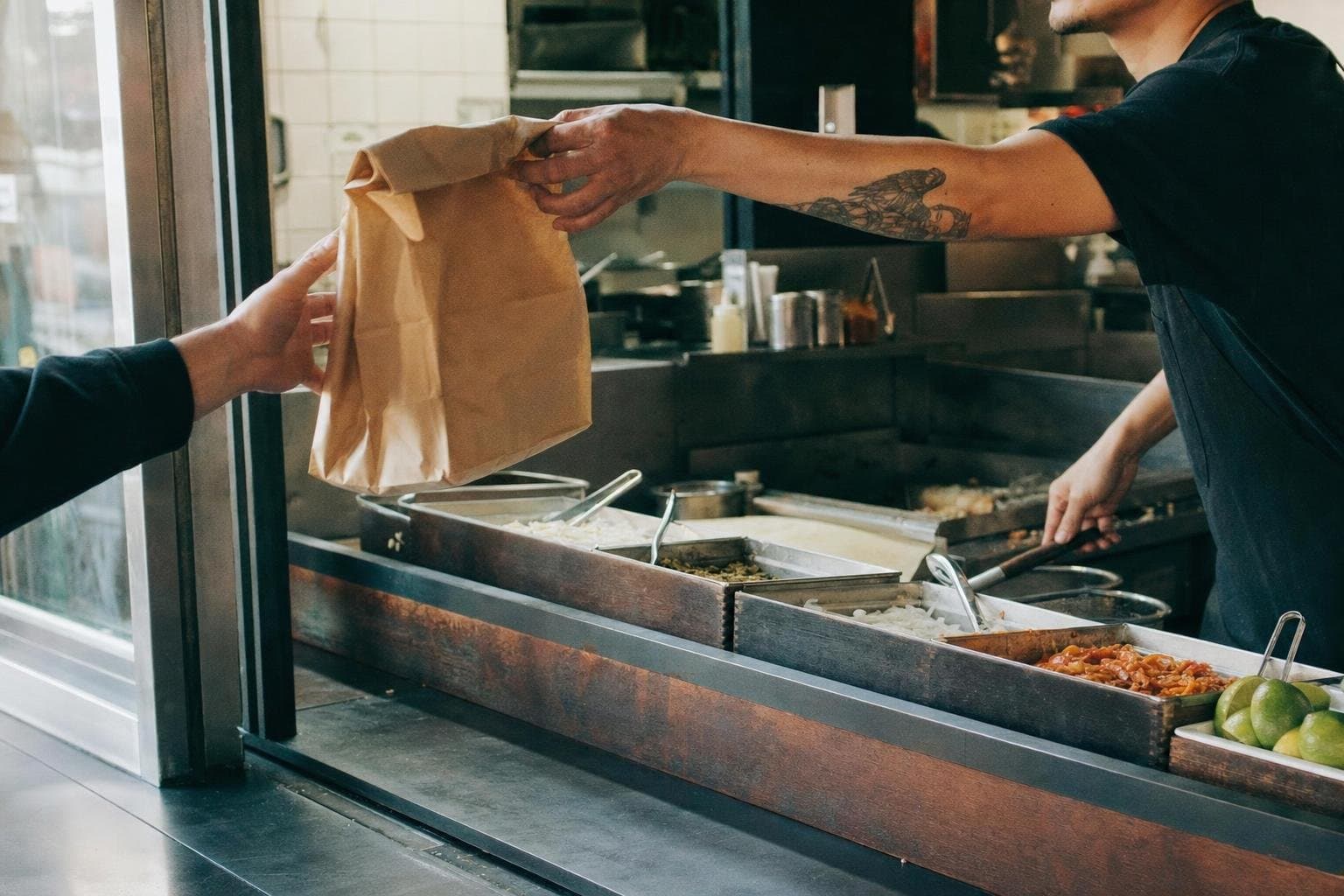
A quick-service restaurant rarely takes a table booking, so the textbook No-show barely exists here. The economic equivalent absolutely does. Every busy signal at noon, every drive-thru car that balks at a stalled lane, and every mobile order that reaches the kitchen and is never collected is a lost cover you already paid to attract through your app, your signage, or First-party ordering. Reframed for this niche, the reservations-and-no-show toolkit is about three demand surfaces: the drive-thru, the phone, and order-ahead, and making each one capture and confirm the ticket automatically so nothing is dropped when the line is deepest.
The stakes are volume times a thin margin. Mobile ordering is now mainstream at 57% of adults, and a QSR that cannot answer the phone or keep the drive-thru moving during its 90 busiest minutes is leaking its most profitable revenue at exactly the moment it is hardest to staff for.
Drive-thru and phone voice AI at volume, and its honest ceiling
Drive-thru AI is the highest-volume guest-facing AI in the industry, and it is being deployed at real scale. Wendy's Fresh AI has reached 160+ locations, 500 planned, Taco Bell has expanded voice AI to 890+ Taco Bell locations across 38 states, and Dairy Queen rolled out Presto Automation across 25+ states/provinces. Vendors built for a QSR lane include Presto Automation, ConverseNow, SoundHound AI (for Restaurants), and Hi Auto, most of which sit on top of your existing Point of sale (POS) rather than replacing it.
Be honest about the ceiling: this is production-grade, not autonomous. In a mystery-shopper study of confirmed voice-AI drive-thru visits, 22% employee intervention rate, and 2.5-year test ended. Read that plainly. Voice AI reliably takes the routine order and frees a crew member, but a human still supervises the headset and steps in on the messy tickets, the large modifications, and the accents or noise the model misses. Deploy it to add capacity, not to remove your last person from the lane.
The phone is the easier, lower-risk win. A voice agent such as Slang.ai answers every inbound call, quotes an accurate pickup time, and takes the order without anyone leaving the line. Slang reports restaurants drive Up to 50% more phone covers / 96%+ satisfaction with its agent. Upselling is a quiet bonus on both surfaces: drive-thru voice AI makes far more context-specific offers than a rushed crew, and Presto reports upselling can lift drive-thru revenue by up to +6% revenue.
Forecast the rush so prep and labor land on demand, not on a hunch
The part of reservation thinking that does translate cleanly to a QSR is Demand forecasting. You cannot overbook a dining room, but you can badly under-prep a Friday lunch or over-schedule a dead Tuesday, and both cost real money at these margins. AI forecasting reads your POS history, dayparts, and weather to predict covers and item mix by the hour. Lineup.ai markets its sales forecasting as 35% more accurate, and 7shifts, used by 55,000 restaurants / 1.5M workers, turns that forecast into a schedule.
Labor is your second-biggest controllable and the one this most directly protects: limited-service Labor cost percentage ran a median of 31.7% of sales in 2024, so trimming even a point of over-scheduling while staying covered at peak drops straight to the bottom line. The savings are concrete: independent operator Cali BBQ used AI to analyze historical sales and hold its open until 11:00 AM, $4,000 saved, a call the model made in under a minute.
Close the loop on the no-show equivalent with automated confirmations. Text reminders reduce unclaimed pickup orders, and guests are receptive: nearly ~50% prefer restaurant texts, especially for time-sensitive updates like an order-ready alert. On Toast's platform, automated confirmations helped hold no-shows to ~2% of booked reservations were no-shows, the same mechanic that keeps a QSR pickup shelf from filling with orders nobody comes to get.
Where to start without betting the lane
Sequence it by risk. Start with the phone agent, because a missed call is pure lost revenue and a phone bot fails softly (worst case, it takes a message). Add order-ahead confirmations next, since they need no new hardware and directly cut unclaimed tickets. Layer in forecasting and scheduling on the data you already have in Toast or Square for Restaurants. Save drive-thru voice AI for last: it is the highest-value surface but also the one that most needs a supervised rollout, a clear human-intervention path, and a lane you can revert if accuracy dips during a rush.
Keep the guest-facing pieces on First-party ordering where you can, through your POS or an ordering layer like Olo, so the demand data feeds your own forecast instead of a marketplace's. The goal is one connected loop: capture the order on any surface, confirm it automatically, and let the forecast staff and prep for it.
Questions quick-service restaurant operators ask
My QSR doesn't take reservations, so does any of this apply?
How accurate is drive-thru voice AI really?
What does this cost for a single location, and where is the ROI?
Will voice AI slow down my drive-thru times?
How do I stop mobile and phone orders from going unclaimed?
References
Every figure on this page drills down.
23 sourced statistics cited here across 17 publications. Each number links to the research hub, and each entry there links out to its primary source.
- 01National Restaurant Association, From Trend to Transformation: Off-Premises Dining Now Essential (2025)
- 02Nation's Restaurant News, The disappearing front of house: How AI fills the gap when good people are hard to find (2025)
- 03Restaurant365, What Is the Average Profit Margin for a Restaurant? (2024)
- 04Restaurant Dive, Wendy's to deploy drive-thru AI to over 500 restaurants this year (2025)
- 05The Next Web, Taco Bell's voice AI expansion shows the drive-thru has entered a new phase (2025)
- 06Nation's Restaurant News, Dairy Queen rolls out voice AI for the drive-thru (2025)
- 07Nation's Restaurant News (citing NRA State of the Industry 2025), Tech fatigue: Why some restaurants are hitting pause on tech investments (2025)
- 08Slang AI, Slang AI homepage (2026)
- 09Presto Automation, Presto Voice: AI-Driven Drive-Thru Automation (2026)
- 10Lineup.ai, Lineup.ai | AI Forecasting Software for Restaurants (2026)
- 117shifts, AI Information Page for 7shifts (2026)
- 12National Restaurant Association, Elevated labor costs had a significant impact on restaurant profitability in 2024 (2025)
- 13Restaurant Technology (Shawn Walchef, Cali BBQ) on Substack, The Future of Tech is Agentic: How Toast IQ Saved Us $4,000 (2025)
- 14SevenRooms, Improving Your Restaurant Waitlist Management with a Virtual Waitlist (2024)
- 15Toast (via The Globe and Mail), Toast Data: How Reservation and Full-Service Restaurant Dining Trends Shifted In the Last Year (2025)
- 16Restaurant Dive, OpenTable launches initiative to combat diner no-shows (2024)
- 17The Philadelphia Inquirer, OpenTable begins adding a 2% service fee to some transactions, including no-show fees (2026)
Your next service / Ready when you are
Start with reservations & no-shows for your quick-service restaurant
Turn what you have learned into a focused brief. Start with the job that matters most, and keep the tools that already work for your restaurant.
Describe it. Review it. Keep improving it. Check connections and costs before going live.