Quick service (QSR) / AI phone answering
AI phone answering for quick-service restaurants
By the numbers
Source: Nation's Restaurant News
Source: Restaurant Dive
Source: Toast (via The Globe and Mail)
Source: Toast (via The Globe and Mail)
The quick service (QSR) problem
How AI helps a quick-service restaurant here
- Answers every inbound call on the first ring with no hold, so a phone order never competes with the drive-thru window for a crew member's attention.
- Takes order-ahead and pickup orders by voice and drops them straight into your Point of sale (POS), the same lane ConverseNow and SoundHound AI (for Restaurants) run at QSR volume.
- Handles the FAQ flood (hours, location, allergens, whether you are open on the holiday) that eats crew time but never needed a person.
- Upsells on every order the way it greets every order: drive-thru voice AI makes about 4x more context-specific upsell attempts than staff, and Presto reports it can lift drive-thru revenue up to +6% revenue.
- Feeds clean order timestamps and volume back into Demand forecasting for prep and tighter Labor cost percentage scheduling, so the rush is staffed before it hits.
- Fires the order-ready text automatically, meeting the bar where 42% expect reply in 15 min / 66% within 1 hour.
The phone and the drive-thru are the same problem
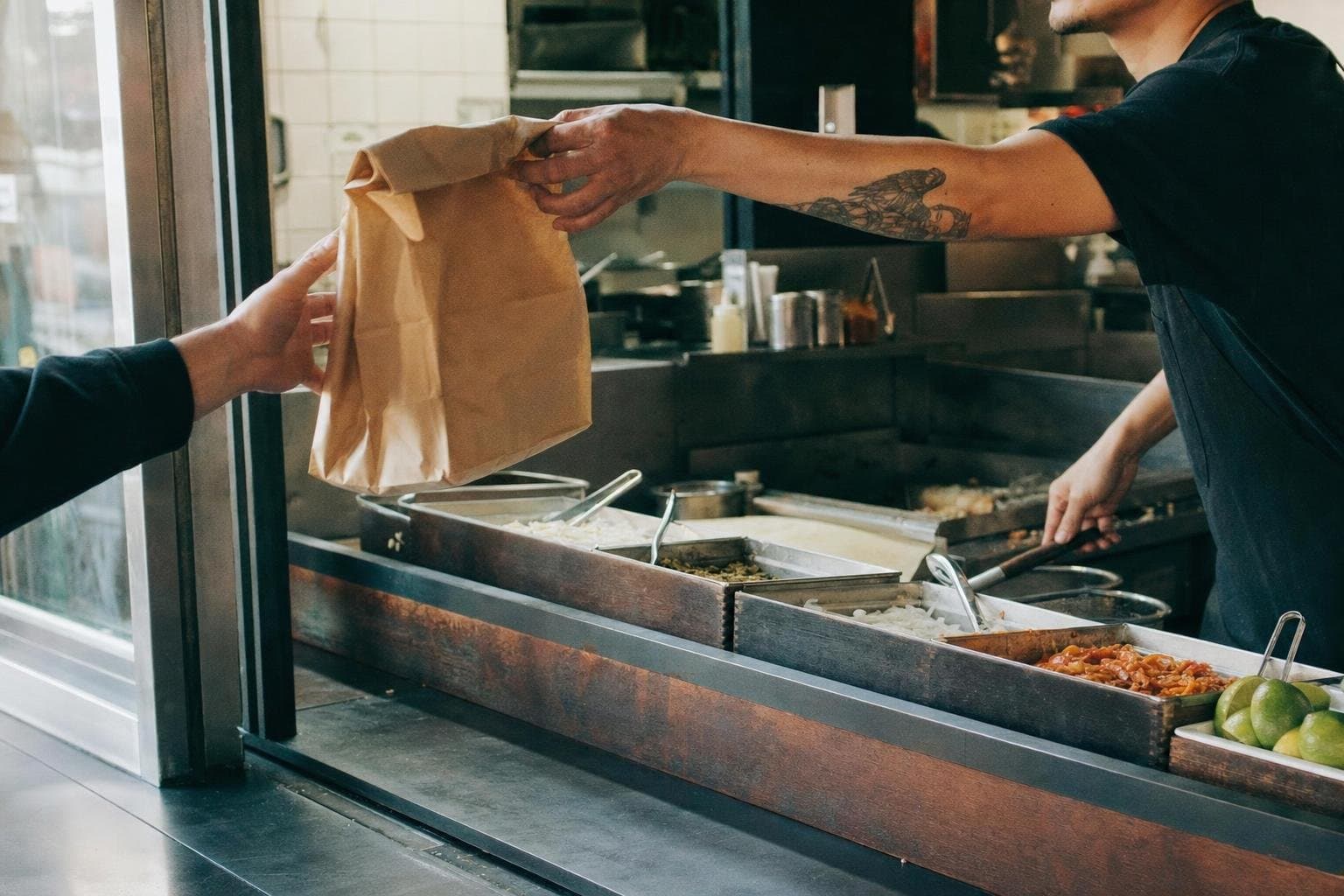
In a QSR, phone answering is not a front-of-house nicety, it is a throughput valve on the same crew that runs the window. When both ring at once, one of them loses, and the math says it is usually the phone: an estimated 40% unanswered / $20B lost annually of restaurant calls go unanswered. A voice agent decouples the two. It answers the phone in parallel while your people stay on the make-line, and it captures the order-ahead and pickup calls that a busy QSR quietly drops all day.
The bigger prize is the drive-thru itself, which is why the marquee QSR deployments are voice ordering, not switchboards. Wendy's Fresh AI has rolled to 160+ locations, 500 planned, Taco Bell has expanded voice AI to 890+ Taco Bell locations across 38 states, and Dairy Queen deployed Presto across 25+ states/provinces. For an independent, the same Drive-thru AI engines from ConverseNow, SoundHound AI (for Restaurants), and Hi Auto are available per-location without a chain-scale contract.
Be honest about accuracy, because your margin is
Voice AI at a QSR is production-grade, not hands-off. In a mystery-shopper study of 120 confirmed voice-AI drive-thru visits, employees still had to intervene in 22% employee intervention rate of interactions, and even McDonald's ended a 2.5-year test ended with IBM. Treat the agent as a fast, tireless order-taker that a human supervises, not a replacement for one. The design that works is a confirmation screen the guest sees, an easy crew override, and a clean handoff to a person on anything the model is unsure about.
That caution is a margin decision, not a technophobic one. QSR nets 3-5% net margin, so a wrong drive-thru order is not just a remake, it is a comped ticket plus the food cost of the mistake. The right accuracy bar is set by what a re-fire costs you, which is why the honest version of this is supervised automation on the highest-volume, most-scripted items first, expanding only as the error rate proves itself on your own menu.
- Start with pickup and order-ahead phone calls, the lowest-risk, highest-frustration lane.
- Add drive-thru voice on your simplest, highest-frequency combos before your full menu.
- Keep a one-tap crew override and always show the guest a confirmation of what was heard.
The data the phone throws off is worth as much as the calls
Every call your agent answers is a timestamped, itemized record, and at QSR volume that is the raw material for prep and labor. Fed into Demand forecasting, it tells the kitchen how much to par out before the noon wave and tells the schedule who to have on the make-line, against a labor line that runs 31.7% of sales of sales. Forecasting tools like 7shifts (used by 55,000 restaurants / 1.5M workers) and Lineup.ai, which markets itself as 35% more accurate than traditional methods, turn that call and POS history into a staffing and prep plan.
It also builds First-party ordering muscle. A phone or drive-thru order captured by your own agent, dropped into your POS, is a guest relationship you own outright, not a commission you rent. That matters when the alternative channels take a real bite and the phone is a channel you already have. See the general AI phone answering page for the cross-niche mechanics, and /tools for a side-by-side on the voice platforms.
Questions quick-service restaurant operators ask
What does a per-location voice agent actually cost a single QSR?
Will it get orders wrong and cost me remakes?
Do I need a drive-thru for this to be worth it?
Will an AI voice annoy my regulars?
References
Every figure on this page drills down.
22 sourced statistics cited here across 18 publications. Each number links to the research hub, and each entry there links out to its primary source.
- 01Nation's Restaurant News, The disappearing front of house: How AI fills the gap when good people are hard to find (2025)
- 02National Restaurant Association, From Trend to Transformation: Off-Premises Dining Now Essential (2025)
- 03National Restaurant Association, Elevated labor costs had a significant impact on restaurant profitability in 2024 (2025)
- 04Restaurant365, What Is the Average Profit Margin for a Restaurant? (2024)
- 05Presto Automation, Presto Voice: AI-Driven Drive-Thru Automation (2026)
- 06EZ Texting, 2024 SMS Marketing Consumer Behavior Report (2024)
- 07Restaurant Dive, Wendy's to deploy drive-thru AI to over 500 restaurants this year (2025)
- 08The Next Web, Taco Bell's voice AI expansion shows the drive-thru has entered a new phase (2025)
- 09Nation's Restaurant News, Dairy Queen rolls out voice AI for the drive-thru (2025)
- 10Nation's Restaurant News (citing NRA State of the Industry 2025), Tech fatigue: Why some restaurants are hitting pause on tech investments (2025)
- 117shifts, AI Information Page for 7shifts (2026)
- 12Lineup.ai, Lineup.ai | AI Forecasting Software for Restaurants (2026)
- 13Slang.ai, Slang AI Pricing | Restaurant Voice AI Plans (2026)
- 14Restaurant Technology News, ConverseNow Partners with Adora POS to Streamline Pizza Ordering with Voice AI Technology (2024)
- 15Slang AI, Slang AI homepage (2026)
- 16Restaurant Dive, OpenTable launches initiative to combat diner no-shows (2024)
- 17Toast (via The Globe and Mail), Toast Data: How Reservation and Full-Service Restaurant Dining Trends Shifted In the Last Year (2025)
- 18The Philadelphia Inquirer, OpenTable begins adding a 2% service fee to some transactions, including no-show fees (2026)
Your next service / Ready when you are
Start with AI phone answering for your quick-service restaurant
Turn what you have learned into a focused brief. Start with the job that matters most, and keep the tools that already work for your restaurant.
Describe it. Review it. Keep improving it. Check connections and costs before going live.